Module

Manufacturing ERP and MRP-ready production control

Plan BOMs, routings, work centers, manufacturing orders, material consumption, shortages, finished goods, and production variance from one controlled workflow.

Xfatora Manufacturing gives production teams an ERP workflow for bills of materials, routings, work orders, material readiness, consumption, finished-goods receipt, and MRP-ready handoffs with inventory and procurement.

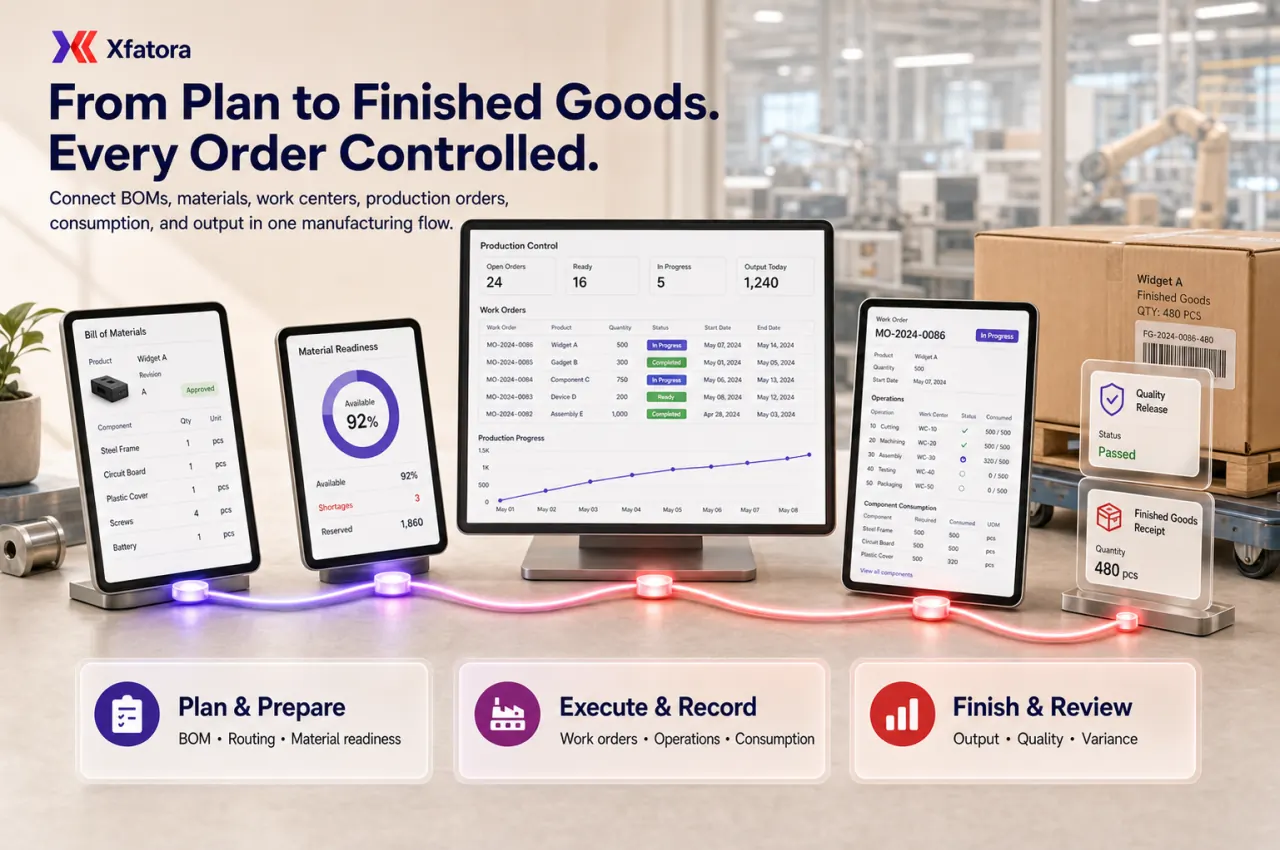
Visual overview of Manufacturing ERP and MRP-ready production control

What this module helps you control

Manufactured products, variants, SKUs, units of measure, and production master data

Bills of Materials with component quantities, units, revisions, and change discipline

Routings, ordered operations, work instructions, and expected operation durations

Work centers with capacity assumptions, efficiency, cost/hour, and ownership context

Manufacturing orders from planned quantity and dates through release and completion

Material readiness checks, reservations, shortages, and consumption behavior

Component warehouse issue and finished-goods warehouse receipt handoffs

Purchase request creation when component shortages block production continuity

Production cost context, material cost, labour cost, duration deviation, and variance review

MRP-ready planning inputs such as demand, lead time, reorder points, stock availability, and procurement handoffs

Business outcomes teams expect

Build more repeatable production setup using standardized products, variants, BoM, routings, and work centers.

Keep cleaner Bill of Materials discipline with controlled component quantities and unit handling.

Improve routing and work-center visibility so teams know operation order, expected duration, and ownership.

Clarify production ownership with manufacturing order and work order status control from draft to done.

Control real component consumption with readiness checks and qty to consume/reserved/consumed records.

Align production output with inventory through governed component issue and finished goods receipt handoff.

See shortage risks earlier and create purchase request records from manufacturing when components are missing.

Strengthen finished-goods traceability with order-level quantity produced, warehouse receipt, and production history.

Improve production cost and variance understanding with total material cost, labour cost, and duration deviation visibility.

Run more reliable operations reviews for throughput, bottlenecks, and recurring master-data improvements.

Screenshots

Real screens from the platform.

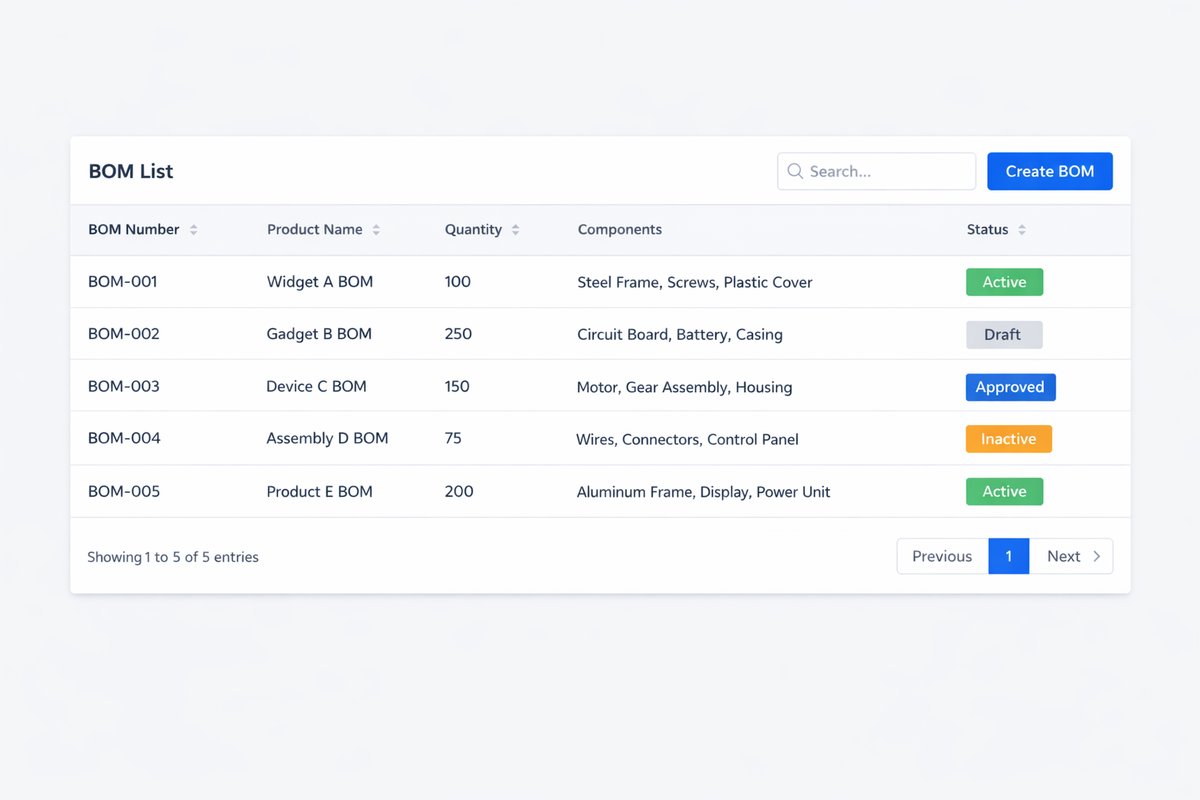
BOM list (Manufacturing)
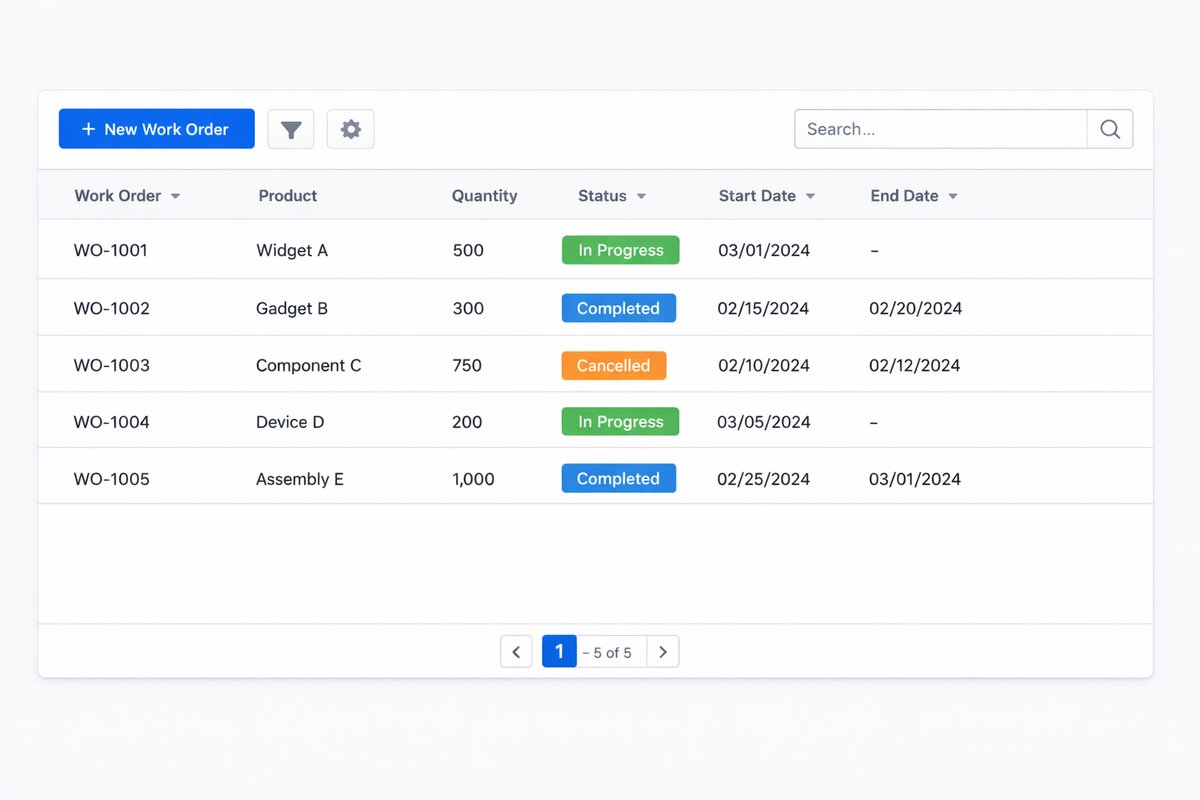
Work orders (Manufacturing)

What teams use most in this module

Practical capabilities that make day-to-day execution faster, cleaner, and easier to govern.

Products and Product Variants

Define manufactured products and product variants with clear readiness rules so planning and execution teams work from trusted production masters.

Manufactured products and variant structures
Product type and category controls
SKU and barcode context
Sales, purchase, and manufacturing flags
Readiness checks before production use

Bills of Materials (BoM)

Maintain bills of materials with component-level discipline so repeat production uses consistent inputs and quantity standards.

Bills of materials linked to products
Components with required quantities
Units of measure for each line
Apply BoM on variants where needed
Revision and change discipline for repeatable builds

Units of Measure and Quantity Control

Use unit categories, reference units, and ratios to keep component and output quantities consistent across BoM and production execution.

Unit of measure categories
Reference unit definition
Ratio and conversion control
Quantity precision governance
Cleaner quantity consistency across records

Routings and Operations

Structure production steps with routings and ordered operations so teams execute work in a controlled, repeatable sequence.

Routings by manufactured product
Ordered operations and step sequence
Default duration per operation
Start next operation logic
Notes and work instruction fields

Work Centers

Define work centers with operational planning assumptions so supervisors can allocate workload with clearer capacity and cost context.

Work center name and code
Working hours settings
Capacity assumptions
Time efficiency factors
Cost per hour reference

Manufacturing Orders

Plan and release manufacturing orders with target quantities, owners, dates, and statuses for end-to-end production execution visibility.

Manufacturing order code/reference
Quantity to produce and planned output
Planned start and planned finished dates
Responsible owner assignment
Draft / planned / confirmed / in progress / done / canceled statuses

Work Orders and Shop-Floor Execution

Execute work orders by operation and work center with practical status updates to keep supervisors informed of production progress.

Work order records per operation
Work center assignment for execution
Current production and quantity in production
Start working, pause, continue, and done actions
Structured shop-floor progress tracking

Material Readiness and Consumption

Validate material readiness before release and enforce consumption behavior during execution to reduce uncontrolled usage.

Manufacturing readiness checks
Qty to consume, reserved, and consumed visibility
All components available logic
First operation component availability logic
Strict versus flexible consumption behavior

Components Warehouse and Finished Products Warehouse

Coordinate component issue and finished goods receipt with explicit warehouse handoff records without turning manufacturing into warehouse operations.

Components warehouse source control
Finished products warehouse destination control
Issue and receipt handoff evidence
Component depletion visibility
Finished-goods increase after completion

Purchase Request Creation for Shortages

Create purchase request records from production shortages so planning can recover continuity when required components are unavailable.

Create purchase request from manufacturing context
Shortage-driven procurement request flow
Reference purchase request linkage
Production continuity support when stock is insufficient
Recurring shortage visibility for planning review

Production Costing and Variance

Review material, labour, and work-center cost context with duration variance so management can evaluate production performance and corrective actions.

Cost/Hour references
Total Material Cost visibility
Total Labour Cost visibility
Total work center cost context
Duration deviation and expected-versus-actual analysis

BoM Change Logs and Traceability

Maintain an audit trail for engineering and production master-data changes so BoM updates stay reviewable and accountable.

BoM changes logs
Change type tracking
Quantity change records
Date and time history
User-level change accountability

Start with this workflow

Follow these structured steps to launch one controlled process first, then expand.

MRP-ready rollout sequence

1

Clean product, variant, unit, warehouse, and supplier master data

2

Approve BoM and routing ownership before production orders are released

3

Define lead times, reorder rules, safety stock, and material readiness checks

4

Connect shortages to procurement requests instead of manual follow-up

5

Test one product family from demand to finished goods before expanding

Create a BOM for a manufactured product

1

Select or create the manufactured product

2

Define the component list and required quantities

3

Choose units of measure for each component

4

Review BoM completeness and readiness

5

Approve and standardize the BoM for production use

Create routing and work centers

1

Define work centers with planning assumptions

2

Create the routing for the product

3

Add ordered operations

4

Assign durations and work instruction notes

5

Validate routing against actual production flow

Create and release a manufacturing order

1

Choose product and quantity to produce

2

Select the applicable BoM and routing

3

Set planned dates and responsible owner

4

Check material readiness and shortages

5

Confirm and release the order to execution

Execute work order and consume materials

1

Start the assigned work order

2

Progress through operations by sequence

3

Record component consumption during execution

4

Handle pauses or waiting states as needed

5

Continue production until completion

Post finished goods and close the order

1

Record quantity produced

2

Post finished goods to the target warehouse

3

Verify component issue and finished-goods receipt handoff

4

Mark manufacturing and work orders done

5

Review time and quantity variance

Handle component shortage with purchase request

1

Identify missing component availability

2

Create purchase request from manufacturing

3

Track shortage impact on release or execution

4

Resume planning once material becomes available

5

Review recurring shortage patterns

Who this module is for

Manufacturing administrator controlling products, BoM, routings, and work centers

Production planner responsible for release dates, quantities, and material readiness

Production supervisor tracking work orders, bottlenecks, and shop-floor progress

Warehouse coordinator managing component issue and finished-goods receipt

Procurement owner handling shortage-driven purchase requests

Operations manager reviewing throughput, variance, and recurring production blockers

Finance or costing reviewer checking material, labour, and production cost context

Common problems this module helps solve

Bills of Materials are managed in spreadsheets and differ from actual production usage

Production starts before required components are available or reserved

Work orders are tracked informally, so supervisors cannot see true progress

Shortages are discovered too late and purchase requests are created manually

Finished goods are posted without a clear link to consumed components

Routing steps and work-center capacity assumptions are not documented

Production cost and material variance are reviewed after the fact

Inventory, procurement, and accounting teams rebuild production context manually

The company wants MRP planning but has not stabilized master data and execution handoffs

Where teams apply this module

Discrete manufacturing teams standardizing BoM, routing, and work-center setup

Factories that need a controlled path from planned order to finished goods

Production teams moving from spreadsheets into repeatable manufacturing execution

Companies that need material readiness checks before releasing orders

Inventory-heavy manufacturers that need production linked to stock movement

Procurement teams that need shortage visibility from manufacturing demand

Organizations preparing for a stronger MRP rollout after stabilizing master data

Connected records across modules

Inventory: checks component availability, reserves or consumes materials, and receives finished goods.

Procurement: receives shortage-driven purchase requests when required components are missing.

Accounting: reviews material, labour, work-center cost context, and period production impact.

CRM and Sales: can provide demand context when production is linked to customer orders or forecasts.

Exports: supports production audit packs, BoM review, variance analysis, and migration checks.

MRP planning: becomes stronger when lead times, reorder points, safety stock, supplier timing, and demand signals are defined.

Built-in Reports & Analytics

Manufacturing order status and production progress review

Work order status by operation and work center

Planned versus actual output and completion review

Material readiness, shortage, reservation, and consumption review

Component issue and finished-goods receipt handoff evidence

Work center duration, cost/hour, and deviation visibility

Production material cost, labour cost, and variance context

BoM changes log and master-data traceability

Shortage-driven purchase request follow-up

Compliance & Implementation Resources

Practical guides to help you rollout and validate workflows.

FAQ

Can we define repeatable BoM for manufactured products?

Yes. Manufacturing supports bills of materials with component quantities and units of measure so repeated production follows the same standards.

Can we manage routings and work centers?

Yes. You can structure routings, operation order, work instruction notes, and work-center assumptions including cost/hour context.

Can we issue manufacturing orders and work orders?

Yes. Orders support planned quantity, dates, ownership, and operational statuses from draft through done or canceled.

Can we record material consumption and finished goods output?

Yes. Manufacturing tracks component consumption and posts finished goods into the designated finished products warehouse.

Can the module check material readiness before production?

Yes. Readiness checks can confirm all required components, or first-operation components, before release decisions.

Can we trigger purchase requests when components are short?

Yes. Manufacturing can create purchase request records from shortage conditions to support production continuity.

Can we review production cost and variance?

Yes. Teams can review total material cost, total labour cost, work-center cost context, and duration deviation for management review.

How should Manufacturing differ from Inventory?

Manufacturing controls how products are built (BoM, routings, orders, and consumption), while Inventory controls stock balances and warehouse movement governance.

How should Manufacturing differ from Procurement?

Manufacturing controls production execution. Procurement controls supplier sourcing and purchasing decisions, including requests generated from production shortages.

Who should control BoM and routing changes?

BoM and routing changes should stay with designated Manufacturing Admin or engineering owners, while execution teams follow approved masters.

Is Xfatora Manufacturing a full MRP system?

It provides the execution and master-data foundation for an MRP-ready rollout: products, BoM, routings, work centers, orders, material readiness, consumption, shortages, and inventory/procurement handoffs. A full MRP rollout also needs planning rules such as lead times, demand signals, reorder points, safety stock, supplier timing, and planning ownership.

What should we prepare before a manufacturing demo?

Prepare one finished product, its BoM, component stock situation, routing steps, work centers, a recent shortage example, and the reports management uses to review production.

How does manufacturing connect to inventory?

Inventory provides component availability and receives finished goods. Manufacturing controls how materials are consumed and how production output is posted back to warehouse records.

How does manufacturing connect to procurement?

When components are short, manufacturing can create purchase request records so procurement can act on real production needs instead of separate spreadsheet requests.

Plans that include this module

Confirm commercial fit before rollout planning.

Enterprise Plan

Ready to evaluate Manufacturing ERP and MRP-ready production control with your team?

We will map this module to your current process, owners, controls, and rollout timeline.

User guide

How to use Manufacturing ERP and MRP-ready production control

Setup checklist, key workflows, reports, and troubleshooting.

Request a Demo

Tell us what you need and we will reply with a rollout plan and recommended modules.

Fields marked with * are required.

Related content

Related Modules

Often fits plan: Enterprise

AI Sales Assistant

Use AI-assisted calling and qualification workflows to improve first-contact consistency, lead follow-up, call summaries, and CRM handoff discipline.

Often fits plan: Enterprise

Asset Management

Control asset records, custody, locations, maintenance, audits, depreciation, and lifecycle accountability from one controlled workspace.

Often fits plan: Enterprise

Asset Management

Manage company assets, custody, locations, maintenance, audits, depreciation, and lifecycle accountability from one controlled workspace.

Related Use Cases

Accelerate Order to Cash

Connect sales, fulfillment, invoicing, and collections to reduce revenue leakage and improve cash conversion.

order-to-cash revenue-operations cash-flow

Control Production Costs

Tie material usage, labor capture, and overhead allocation to each production order for reliable margins.

manufacturing-management costing inventory-warehousing

Related Industries

ERP for Manufacturing Operations

Manufacturing ERP for production planning, MRP, inventory, quality, costing, and shop-floor control across growing factories.

manufacturing mrp production

ERP for Clinics and Outpatient Networks

Sector playbook covering pain points, workflows, module fit, and buying checklist for erp for clinics and outpatient networks.

industry operations erp

Related Guides

Build ZATCA audit trail controls for SMB finance teams

Practical guide for build zatca audit trail controls for smb finance teams with execution steps and buying support links.

zatca saudi compliance

ERP Implementation Playbook

A practical, phased guide to planning, launching, and scaling ERP adoption across teams with measurable outcomes.

implementation operations change-management