On this page
- Manufacturing pain points that signal an ERP gap
- The workflow from demand to production close
- Master data and bill-of-material governance
- MRP, procurement, and shortage control
- Production scheduling and capacity decisions
- Shop-floor execution and quality control
- Inventory, WIP, and traceability
- Manufacturing costing and financial control
- KPIs for a controlled factory rollout
- Recommended implementation sequence
- Questions to ask during vendor evaluation
- Plan the first manufacturing workflow
Manufacturing pain points that signal an ERP gap
The first warning is usually schedule instability. Production orders are released, moved, or split through calls and messages, so supervisors spend the day reconciling priorities instead of managing flow. Material shortages are discovered only after a work order reaches the line. The purchasing team reacts with urgent orders, but the root cause may be inaccurate bills of materials, unposted consumption, unreliable lead times, or stock held in the wrong location.
The second warning is weak work-in-progress visibility. Management can see raw-material and finished-goods balances, yet cannot confidently explain what is waiting, running, completed, rejected, or blocked between them. This creates false availability, late customer updates, and month-end adjustments. Quality records may also sit outside the production transaction, making it difficult to connect a defect to a batch, operation, supplier, machine, or responsible release decision.
The third warning is margin uncertainty. Standard costs remain unchanged while purchase prices, scrap, cycle times, subcontracting, and overhead behavior move. Teams may know total monthly spend but not which products, customers, orders, or production variances caused the change. An ERP project should therefore connect operational events with costing instead of treating accounting as a separate reporting layer.
The workflow from demand to production close
Start by defining the demand signal. Depending on the factory, demand may come from confirmed sales orders, forecasts, minimum-stock policies, project requirements, or a mix of make-to-stock and make-to-order rules. Each source needs an owner, planning horizon, and confidence level. The system should preserve the difference between forecast demand and committed demand so planners can manage risk without double-counting requirements.
The next step is planning. Material requirements planning calculates what is needed after considering on-hand stock, approved supply, safety stock, lead times, bills of materials, and existing reservations. Capacity planning then checks whether work centers, shifts, labor skills, tooling, and subcontractors can support the proposed dates. Planners should release only feasible orders and manage exceptions such as shortages, overloads, late purchase orders, and engineering changes through visible queues.
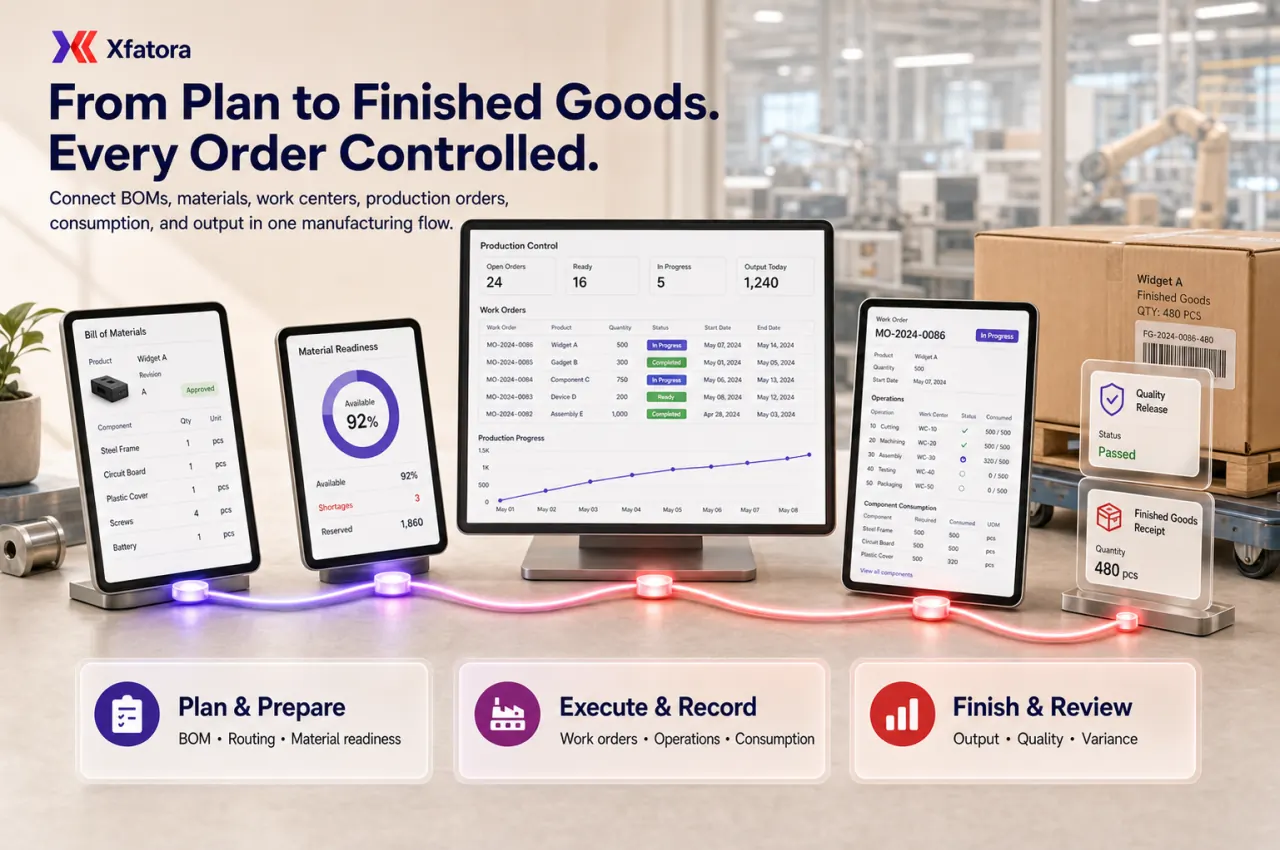
Execution begins when a controlled production order reaches the shop floor. Operators or supervisors record material issues, operation progress, output, downtime, scrap, rework, and completion. Quality checkpoints determine whether material or output can move to the next stage. Finished quantities are received into the correct warehouse or staging location, while actual consumption and time feed product costing. Closing the order should expose unresolved variances rather than hide them in a monthly adjustment.
Master data and bill-of-material governance
Reliable planning depends on reliable master data. Item codes, units of measure, warehouse locations, supplier lead times, lot rules, work centers, routings, and bills of materials must have named owners and controlled effective dates. A factory should not allow every user to change a bill of materials simply because production needs an urgent workaround. Temporary substitutions and permanent engineering changes require different approval paths.
For each bill of materials, define revision control, yield assumptions, scrap factors, alternate components, by-products, and whether quantities scale linearly with batch size. Routings should identify operation sequence, setup time, run time, queue time, required work center, and any mandatory quality gate. These structures allow the Manufacturing module to calculate requirements and compare planned performance with actual execution.
The implementation team should validate master data using representative products rather than importing the full catalog immediately. Select a stable product, a configurable product, a subcontracted step, and a product with quality or traceability requirements. If those scenarios plan and cost correctly, the migration rules can be expanded with far less rework.
MRP, procurement, and shortage control
MRP is useful only when its recommendations can be trusted and acted upon. Planning parameters should distinguish purchased, manufactured, and subcontracted items. Lead times should reflect approval, supplier, transport, receiving, inspection, and internal handling time where material cannot be used immediately. Safety stock should be based on service risk and variability rather than a single percentage applied to every item.
The shortage process must also be explicit. Buyers need a prioritized view of requirements linked to production orders and customer dates. Planners need to see whether a shortage can be resolved through an alternate component, transfer, reschedule, order split, or approved substitution. Supervisors need confirmation that the chosen action is reflected in the released order. Connecting MRP with Procurement reduces repeated entry and keeps purchase decisions tied to real production demand.
Useful controls include approval thresholds for expedited purchases, exception reasons for manual date changes, supplier performance by promised and actual receipt, and alerts for purchase orders that threaten released production. The goal is fewer emergencies, but also better evidence about why emergencies occur.
Production scheduling and capacity decisions
A schedule should be realistic enough to guide daily action. Infinite-capacity dates can support early material planning, but supervisors need a finite view of critical resources before commitments are finalized. Capacity may be constrained by a machine, mold, labor skill, test bench, clean room, subcontractor, or shared setup family. The ERP model should represent the constraint that actually controls throughput.
Scheduling policies should define when orders may be frozen, who can change priority, and how changes are communicated to purchasing, warehouse, quality, sales, and finance. A visual schedule is helpful, but governance matters more than color. If every urgent request bypasses the same rules, the schedule becomes another report that teams ignore.
Factories should monitor planned versus actual start and finish, queue duration, setup loss, schedule adherence, and bottleneck utilization. These measures help distinguish insufficient capacity from poor sequencing, missing materials, maintenance delays, or inaccurate standards.
Shop-floor execution and quality control
Shop-floor recording should be fast enough for the operating environment. Some factories need operator-level transactions at every operation; others can begin with supervisor reporting by order and shift. The right level balances traceability with adoption. Required fields should focus on decisions: quantity completed, quantity rejected, reason code, downtime, material deviation, and next status.
Quality must be part of the transaction flow. Incoming inspection can block supplier material. In-process checks can prevent a defective batch from moving forward. Final inspection can control release to finished goods or shipment. Nonconformance records should capture disposition such as rework, scrap, concession, return to supplier, or investigation. Linking those outcomes to lots, serials, work orders, and costs turns quality data into operational evidence.
Role permissions should separate reporting, approval, and master-data changes. Audit trails should show who released an order, changed a quantity, accepted a deviation, or reopened a closed transaction. This is especially important in regulated or customer-audited environments.
Inventory, WIP, and traceability
Manufacturing inventory is more than a single on-hand balance. Teams need visibility by warehouse, bin, lot, serial, quality status, ownership, and production stage. Material may be available physically but unavailable for planning because it is reserved, quarantined, expired, or assigned to another order. The Inventory and Warehouse module should keep these states visible to planners and supervisors.
Define how material is issued: manually, through pick lists, by backflush, or through a hybrid model. Backflush can reduce transactions for stable, high-volume processes, but it can hide variance when bills of materials or yields are unreliable. Controlled manual issue provides stronger evidence but adds shop-floor effort. The policy should match the risk and maturity of each product family.
Traceability design should begin with the questions the business must answer. Which supplier lots entered this finished batch? Which customers received output from a specific batch? Which operations, machines, and quality results affected it? How quickly can the team isolate stock during a complaint or recall? Designing these questions early prevents expensive reconstruction later.
Manufacturing costing and financial control
Production data should support both operational improvement and financial reporting. Define how material, labor, machine, subcontracting, and overhead costs are collected. Decide whether standards are maintained by product, routing, work center, or cost center, and how often they are reviewed. The Accounting module should receive consistent inventory valuation, WIP, finished-goods, variance, and cost-of-sales entries without requiring manual reconstruction.
Variance analysis should separate causes that require different owners. Purchase-price variance belongs with sourcing decisions. Material-usage variance may indicate scrap, substitution, inaccurate bills, or reporting gaps. Labor and machine variance may reflect standards, downtime, mix, or execution. Volume and overhead variances require a clear allocation policy. When all differences are combined into one number, teams cannot improve the process behind it.
Before month-end, use exception reports for open orders, negative inventory, missing operation confirmations, unresolved quality holds, abnormal scrap, and unposted subcontracting. Closing these exceptions continuously produces a faster and more credible financial close.
KPIs for a controlled factory rollout
Choose a small KPI set tied to the first rollout scope. Schedule adherence shows whether released orders complete when planned. On-time, in-full delivery connects factory performance with customer commitments. Material shortage frequency shows whether planning and procurement are stabilizing. First-pass yield and scrap rate expose quality loss. Work-in-progress age identifies stalled orders. Inventory accuracy supports every planning calculation.
Additional measures may include overall equipment effectiveness, changeover time, supplier on-time delivery, purchase expedite rate, production lead time, throughput, labor efficiency, and manufacturing cost variance. Every KPI needs a definition, data source, owner, review frequency, and action threshold. Avoid launching a large dashboard before teams agree on transaction discipline.
Recommended implementation sequence
Phase one should establish item, warehouse, bill-of-material, routing, and work-center governance for a controlled product scope. Connect demand, planning, purchasing, production orders, inventory movements, and basic costing. Train each role using real scenarios and confirm that exceptions have owners.
Phase two can expand scheduling, shop-floor detail, quality workflows, maintenance coordination, subcontracting, advanced costing, and management dashboards. Expansion should follow evidence from the pilot rather than a fixed feature list. Review adoption, data accuracy, shortage behavior, schedule stability, and close effort before adding more complexity.
Use a pilot that is important enough to prove value but stable enough to diagnose. Running parallel spreadsheets indefinitely weakens the result, so define when each shadow process will end. Keep a controlled rollback and correction procedure for master data, but make the ERP the operational record once acceptance criteria are met.
Questions to ask during vendor evaluation
- Can the system support both make-to-stock and make-to-order without duplicating item or planning data?
- How are BOM revisions, substitutions, routings, and effective dates controlled?
- Can planners trace MRP recommendations back to demand, stock, supply, and planning parameters?
- How are shortages, overloads, quality holds, and late purchase orders surfaced?
- Can shop-floor users report output, scrap, downtime, and rework with role-appropriate screens?
- How are lot and serial records connected from supplier receipt through production to customer delivery?
- Can actual production activity feed inventory valuation, WIP, product cost, and margin analysis?
- Which implementation evidence is required before adding plants, lines, or product families?
Review related workflows in Procurement, Inventory and Warehouse, Accounting, and Sales and Invoicing. Then compare rollout scope on Pricing and review operational examples in Case studies.
Plan the first manufacturing workflow
Bring one representative product, its demand source, bill of materials, routing, purchasing constraints, quality checkpoints, and costing questions to a guided session. Book a demo to map the first controlled workflow, or review pricing before defining rollout scope.
FAQ
Related Modules
AI Sales Assistant
Use AI-assisted calling and qualification workflows to improve first-contact consistency, lead follow-up, call summaries, and CRM handoff discipline.
Asset Management
Control asset records, custody, locations, maintenance, audits, depreciation, and lifecycle accountability from one controlled workspace.
Asset Management
Manage company assets, custody, locations, maintenance, audits, depreciation, and lifecycle accountability from one controlled workspace.
Attendance and Leave
Manage attendance exceptions, leave requests, approvals, employee availability, payroll cutoffs, and HR reporting from one workflow.
Related Industries
ERP for Retail
Retail ERP guidance for replenishment planning, category performance, omnichannel operations, and margin optimization.
Accounting for Manufacturing | Xfatora
Accounting for Manufacturing: practical workflow guidance, FAQs, and linked modules to evaluate next.
Manufacturing Management for Manufacturing | Xfatora
Manufacturing Management for Manufacturing: practical workflow guidance, FAQs, and linked modules to evaluate next.
Procurement for Manufacturing | Xfatora
Procurement for Manufacturing: practical workflow guidance, FAQs, and linked modules to evaluate next.
Related Use Cases
Control Production Costs
Tie material usage, labor capture, and overhead allocation to each production order for reliable margins.
Accelerate Order to Cash
Connect sales, fulfillment, invoicing, and collections to reduce revenue leakage and improve cash conversion.
Improve Fleet Uptime
Schedule preventative maintenance and coordinate work orders to minimize vehicle downtime.
Improve Project Profitability
Track delivery effort, direct costs, and billing performance to protect project margins.
Related Guides
Build ZATCA audit trail controls for SMB finance teams
Practical guide for build zatca audit trail controls for smb finance teams with execution steps and buying support links.
ERP Implementation Playbook
A practical, phased guide to planning, launching, and scaling ERP adoption across teams with measurable outcomes.
Xfatora User Guide
Module-by-module setup checklists, workflows, reporting, and troubleshooting to help teams roll out Xfatora in phases.
ZATCA Phase 2 Onboarding Guide
Step-by-step onboarding path for Wave readiness, environment setup, and production cutover.
Related Trust Resources
Security Overview
Understand how Xfatora approaches enterprise security across governance, encryption, identity, monitoring, vulnerability management, and procurement readiness.
Xfatora Trust Center
Review how Xfatora approaches implementation trust, data governance, access control, reliability, compliance readiness, customer support, and responsible ERP rollout.
Data Privacy
Review Xfatora privacy commitments across data ownership, lawful processing, retention, deletion, subprocessor transparency, and enterprise contracting support.
Compliance Approach
Learn how Xfatora supports enterprise compliance with governance controls, evidence readiness, control mapping, and procurement collaboration.