
ZATCA readiness confusion
Turn scattered requirements into clear owners, tests, evidence, and an implementation sequence.
Open this pathProblem to solution paths
Operational diagnosis center
A late close, inventory mismatch, or collections chaos may come from incomplete data, unclear ownership, weak approvals, or tools that do not share the same record.
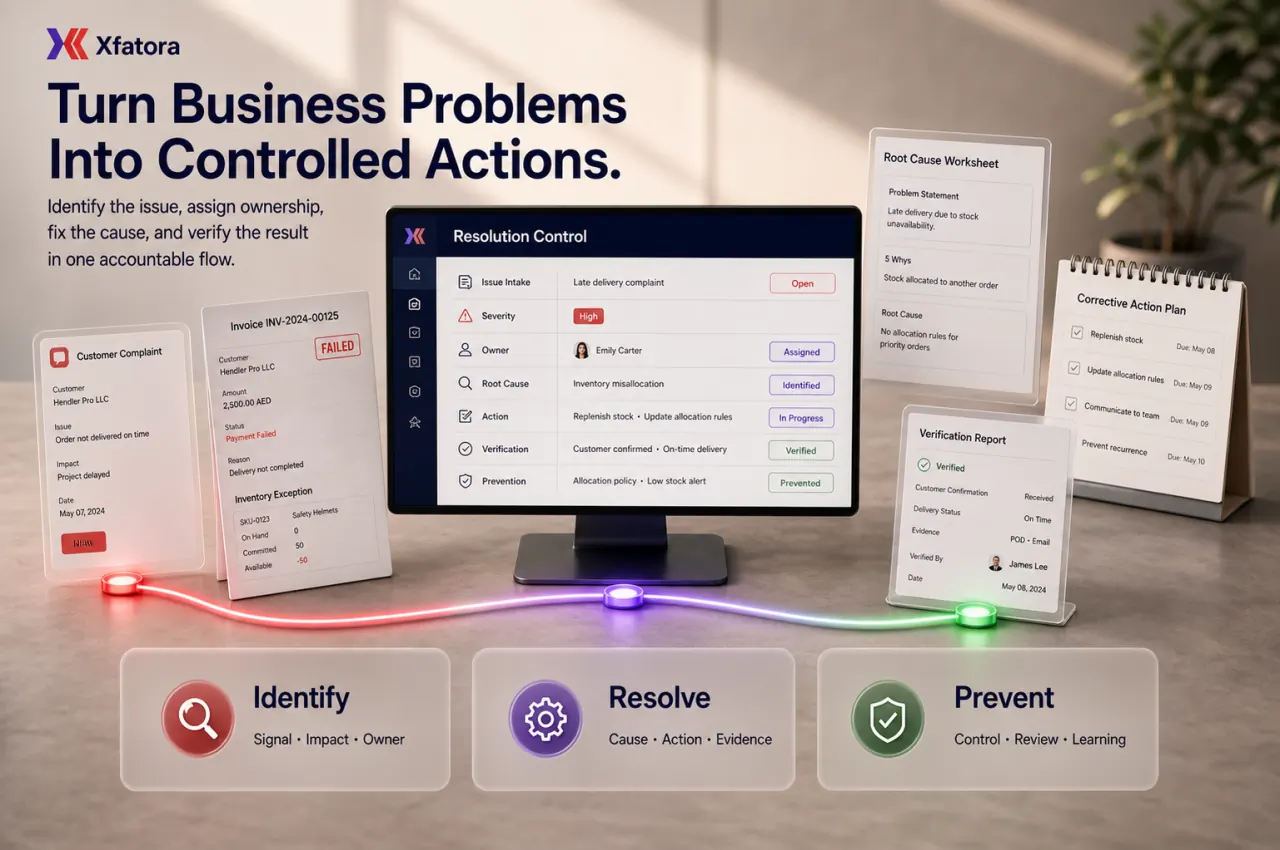
Choose the closest path
Each guide helps separate cause from impact and turn the problem into a scenario you can test.
Turn scattered requirements into clear owners, tests, evidence, and an implementation sequence.
Open this pathFind delay across reconciliations, approvals, source data, exceptions, and reporting.
Open this pathReduce corrections and reissues with better data, review, and approval controls.
Open this pathPrevent duplicate commitment and payment from intake through approval and settlement.
Open this pathMove decisions faster while preserving policy limits, evidence, and audit history.
Open this pathConnect receiving, transfers, issues, counts, adjustments, and the finance impact.
Open this pathUnify priorities, notes, promises, and actions around the customer and invoice.
Open this pathControl requests, budget, approval, and supplier selection before commitment.
Open this pathTurn interest into a decision
A better decision starts with a real workflow and a measurable result, then tests the system against actual roles, data, approvals, and exceptions.
Name the blocked workflow, its owner, and the business impact.
Document steps, approvals, data, handoffs, and exception cases.
Ask vendors to run the real case instead of presenting a generic feature tour.
Document scope, responsibilities, integrations, reports, and success criteria.
Questions before the next step
If the problem repeats across teams or records despite a clear policy, a shared platform may help. If ownership or policy is unclear, fix that first.
Bring a recent example, the people involved, steps and approvals, the exception that occurred, and the result it affected.
Choose one measure close to the problem: cycle time, error rate, exception count, receivable age, or inventory accuracy.
Tell us the urgent workflow, the team that owns it, and the result you need to measure. We will shape the session around that scope and recommend a sensible starting point.